Meta VR Glasses Weigh 100 Grams. What It Means for Clinics

Written by
Shabnam TaherniaShabnam Tahernia on LinkedInHead of Content

Meta VR Glasses are a new virtual reality device Meta announced at its Connect event on September 23, 2026. They weigh about 100 grams, which Meta says makes them five times lighter than Quest 3, and they sit on the face like a pair of glasses instead of strapping around the head. They ship in spring 2027 at $1,299.99.
For clinics, the weight is the headline. A device that goes on like glasses changes how easy it is to offer VR to someone in a treatment chair: less to put on, less to adjust, nothing to tighten. It also comes with trade-offs worth understanding before anyone budgets for one, including a narrower view, open sides and a tethered compute puck. Here is what was announced, what it could mean in a treatment room, and where SendorVR stands.
What did Meta announce?
According to Meta's announcement and the hands-on coverage that followed, these are the facts that matter:
- Weight. About 100 grams on the face, "roughly the same as a deck of cards" in Meta's words. The processor, battery and storage live in a separate puck of about 300 grams, connected by a thin optical cable.
- Display. Micro-OLED panels Meta calls a 5K Infinite Display, at 37 pixels per degree, behind compact pancake lenses. Meta says it is the first IMAX Enhanced certified VR device.
- Controls. Eyes, hand gestures and voice. No controllers are needed, though Touch Plus controllers are optional for games.
- Software. Meta says the glasses get full access to the Meta Quest catalog, with more than 75 games playable by hand at launch.
- Battery. Up to three hours of continuous media playback from the puck, with 45W fast charging.
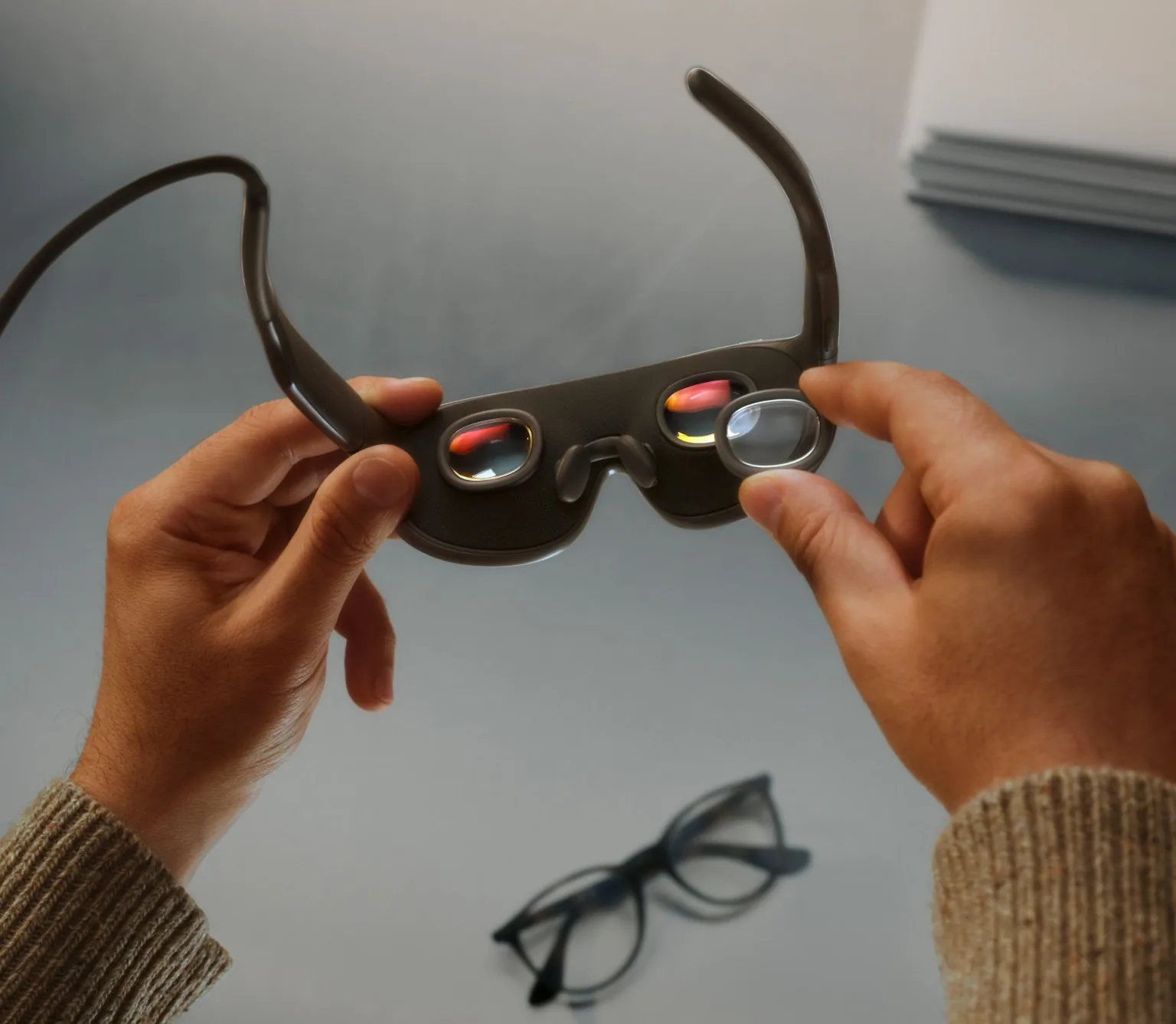
- Fit. Two frame sizes, Standard and Large, several nose pads, and lenses that slide to fit eye spacing (56 to 70 mm), with prescription add-ons available, per Road to VR's hands-on.
- Price and date. $1,299.99, shipping spring 2027.
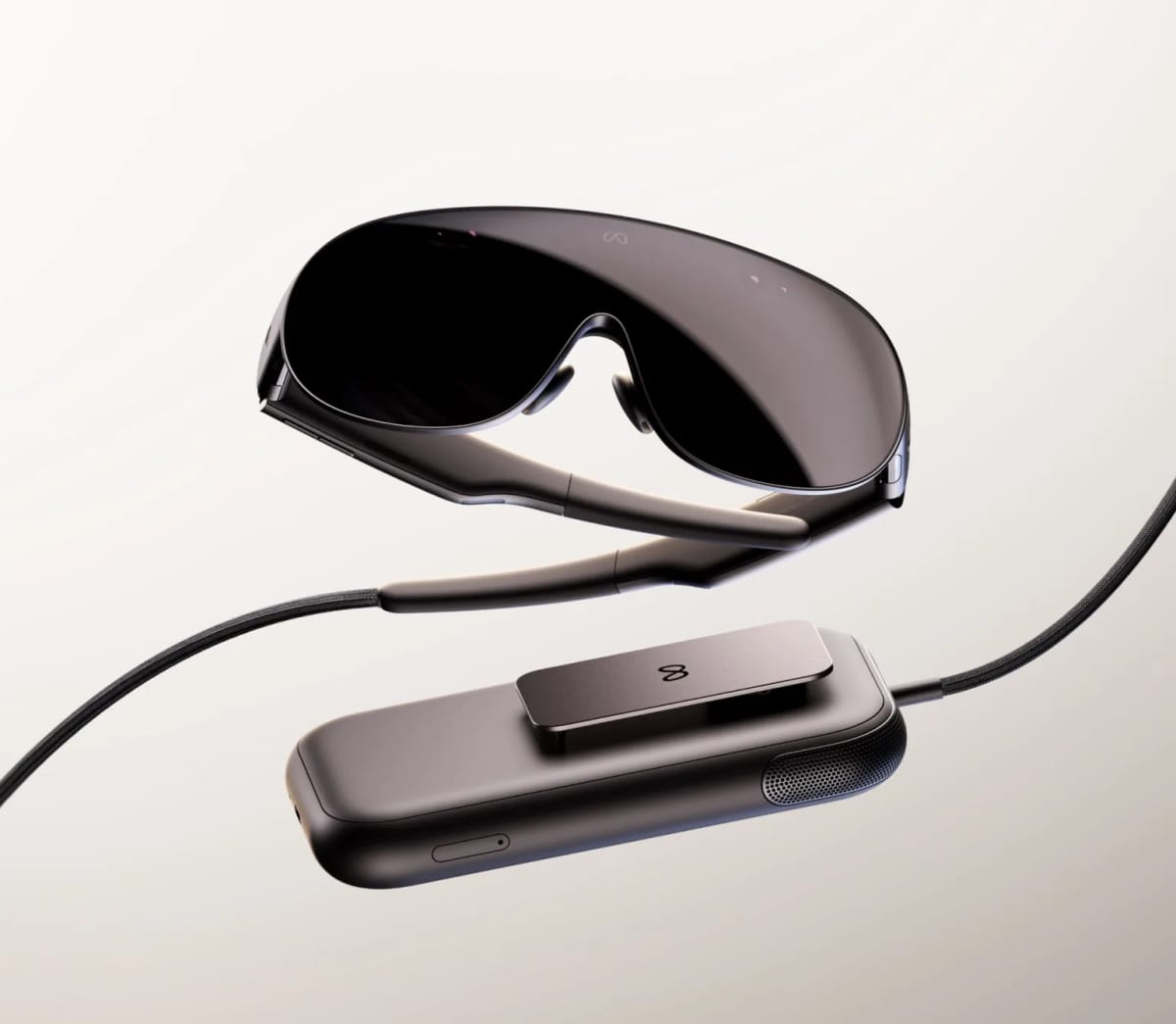
Almost all of the launch was pitched at movies, live sports and working on a giant virtual screen. Nothing in it was aimed at healthcare. The weight is the part that travels.
Meta's hardware team shows how the glasses were designed and built in this short video from Meta's official YouTube channel.
Why does 100 grams matter in a treatment room?
For comparison, Meta Quest 3 weighs 515 grams. It is a very good headset and it is what most VR in care settings runs on today. It is also a strapped box on the face, and in a clinic you are handing it to someone who did not come in for VR.

A few things change when the device feels like glasses.
Faster on, faster off
A comfort session in a clinic often lasts 30 seconds to three minutes, roughly the length of the moment itself. When the whole experience is that short, the time spent loosening a strap, finding the sweet spot and tightening it again is a real share of it. Glasses go on the way sunglasses do.
A shape people already know
Most people have never worn a VR headset. Almost everyone has worn glasses, or at least held a pair. A familiar object may make it an easier yes for the person in the chair, and an easier offer for the nurse making it.

Nothing wrapped around the head
The weight rests on nose pads and temple arms, not a strap, and Engadget's reviewer said the glasses "felt secure throughout my demo and didn't slip around my face." With no rear strap there is nothing to press against a headrest when someone leans back in a reclining chair.
Hands free by design
There are no controllers to hand over, charge or wipe down. Engadget also found the gestures worked with hands resting in a lap. In a room where one arm needs to stay still, that is useful. Our first experience, Bubble Friends, was built hands-only for the same reason.
What are the trade-offs for clinics?
The glasses were designed for watching a film on a plane, not for a draw station, and a few of the choices that make them light cut the other way in a treatment room.
Open sides
The frame is open at the sides and below, so the real room stays in your peripheral view unless you clip in an optional light blocker. That is a sensible choice for a device you wear around the house. In a treatment room, part of the point of an immersive experience is removing stressful sights from view, and "below" is exactly where an arm on an armrest sits. For clinics, the light blocker will probably matter more than it does for anyone else.
A narrower view
The field of view is 70 degrees horizontally. Quest 3's is 110. Road to VR called the difference "noticeably smaller," and said the optical sweet spot is smaller too, so fit matters more. A short, calm experience may not need the full width, but that is something to test in a real room, not assume.
A cable and a puck
The 100 grams on the face is possible because the heavy parts live in a 300 gram puck on a cable. Engadget's reviewer noticed the puck putting out enough warmth that it might be uncomfortable in a pocket. In a clinic it would more likely sit on a tray or a lap, and the cable is one more thing to route away from the arm being worked on.
Sizing and age
Both frame sizes are adult sizes. As of late September 2026, we could not find any age guidance Meta has published specifically for VR Glasses. The minimum age for Quest is 10, and our piece on why VR headsets set a minimum age of 10 explains why a shorter session does not move that line, and why weight is only one of the reasons behind it. Until Meta says otherwise, it is safest to assume the same rules apply.
Price and cleaning
At $1,299.99, the glasses cost a lot more than the headsets most clinics would buy today. Shared devices also need wiping between people, and Meta has said little so far about which surfaces are cleanable. Swappable nose pads are a good start, but the details will matter.
What does this mean for SendorVR?
SendorVR is software. A care team starts a short immersive experience from a browser, on a headset that stays locked in kiosk mode, and one credit is used. Today that headset is a Meta Quest.
Meta says the glasses will run the full Quest catalog, which is encouraging for anything built for Quest, including us. But "should run" is not the same as "works well in a clinic on a Tuesday afternoon." Once the hardware is available, we plan to test it on real devices: kiosk mode, pairing, hands-only experiences, cleaning, and whether the light blocker gives enough immersion for a treatment room. We will not claim support until we have done that.
If you are planning to start with SendorVR at launch in November, keep going with Quest. Nothing announced at Connect makes current headsets obsolete, and the glasses do not ship until spring 2027. The details of what clinics get at launch are in what clinics get when SendorVR launches.
The bigger picture is the direction. Each generation of VR hardware has been lighter and easier to wear than the last, and that suits a product whose whole job is a gentler moment of care. A device that goes on like a pair of glasses is much closer to what a comfort amenity should feel like.
If you want to see what a SendorVR session looks like on the headsets clinics can buy today, book a demo.
Frequently asked questions
How much do Meta VR Glasses weigh?
The glasses weigh about 100 grams. The separate compute puck they connect to weighs about 300 grams. Meta says the glasses are five times lighter than Meta Quest 3, which weighs 515 grams.
When are Meta VR Glasses released and how much do they cost?
Meta says they ship in spring 2027 at $1,299.99 in the US. Prescription add-ons and a clip-in light blocker are available as options, and Touch Plus controllers are sold separately.
Do Meta VR Glasses run Meta Quest apps?
Meta says the glasses get full access to the Meta Quest catalog, with more than 75 games playable with hand gestures at launch. How well each app works on the narrower 70 degree view will vary.
Can children use Meta VR Glasses?
As of late September 2026, Meta had not published age guidance specific to VR Glasses that we could find, and both frame sizes are adult sizes. Meta Quest has a minimum age of 10, with parent-managed accounts for ages 10 to 12.
Will SendorVR work on Meta VR Glasses?
SendorVR runs on Meta Quest headsets today. We plan to test Meta VR Glasses once the hardware is available and will only confirm support after testing kiosk mode, pairing and cleaning on real devices.


