What 21 VR Needle Studies of 2,663 Children Found

Written by
Shabnam TaherniaShabnam Tahernia on LinkedInHead of Content

Twenty one randomized trials, 2,663 children, and a conclusion more interesting than the headline. In 2024 a Spanish research team pooled every randomized trial it could find on virtual reality used as distraction during needle procedures in children and adolescents. Children who wore a headset gave lower scores for pain, fear and anxiety than children who received standard care. Every outcome moved in the same direction, and every difference was statistically significant.
A few pages later, the same authors wrote that their results "do not provide enough evidence to determine the effectiveness of VR", because the studies disagreed with each other too much to pool with confidence. Both sentences are in the same paper, and both are honest. This is what a field looks like when it is genuinely promising and genuinely unsettled at the same time.
What the 2024 review actually pooled
The paper is Cáceres-Matos, Castillo-García, Magni and Pabón-Carrasco, in Nursing Reports. The team searched for randomized controlled trials published between 2014 and 2024, in children and adolescents aged 4 to 21, covering venipuncture, intravenous cannulation, phlebotomy, blood draws and deltoid vaccination.
Twenty one studies met the criteria, and 18 of them reported data usable for meta-analysis. The 2,663 participants split into three groups rather than two: 1,145 used VR, 1,095 received standard care, and 423 received some other distraction technique. That third group matters when reading the headline, because "better than nothing" and "better than a tablet" are different claims.
On methodological quality, 6 studies landed in the highest tier, 11 in the middle, and 4 in the lowest. Blinding of outcome assessment was achieved in roughly 15 percent of them, which is less a failure of effort than a structural fact. A child knows whether there is a headset on their face, and so does the nurse.
How big was the difference
On the Wong-Baker Faces scale, which runs from 0 to 10, children using VR reported 1.83 points less pain than children receiving standard care. Parents watching scored the gap at 2.61 points, and nurses at 2.71. Where pain was measured on numeric rating or visual analogue scales instead, the pooled standardized mean difference was 0.71 in favour of VR, which is a moderate effect by conventional reading.
Fear, measured on the Children's Fear Scale that runs from 0 to 4, came out 1.27 points lower by the child's own scoring. Anxiety, on the Children's Anxiety Meter, came out 2.92 points lower by the child's scoring and 3.87 lower by the parent's.
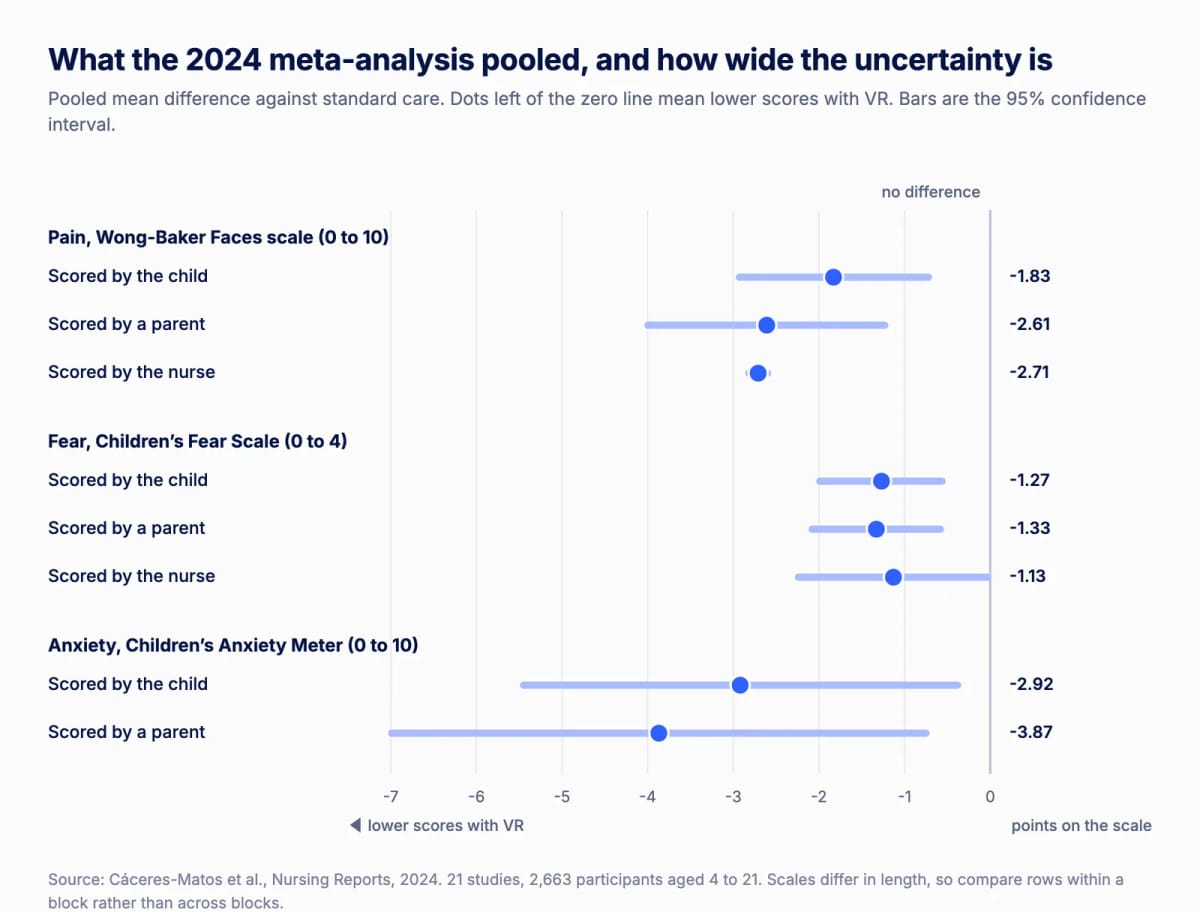
A point or two on a ten point face scale is not a rounding error to a child sitting in the chair. But the width of those intervals is the real story. The pooled anxiety figure of 3.87 points carries a confidence interval running from 6.99 all the way in to 0.75, which is the difference between transformative and barely noticeable.
Why the authors stayed careful anyway
The measure that made them cautious is called I squared. It estimates how much of the variation between studies comes from real differences rather than chance. Above 75 percent, reviewers treat a pooled average as hard to interpret, because the studies are probably not measuring one stable thing.
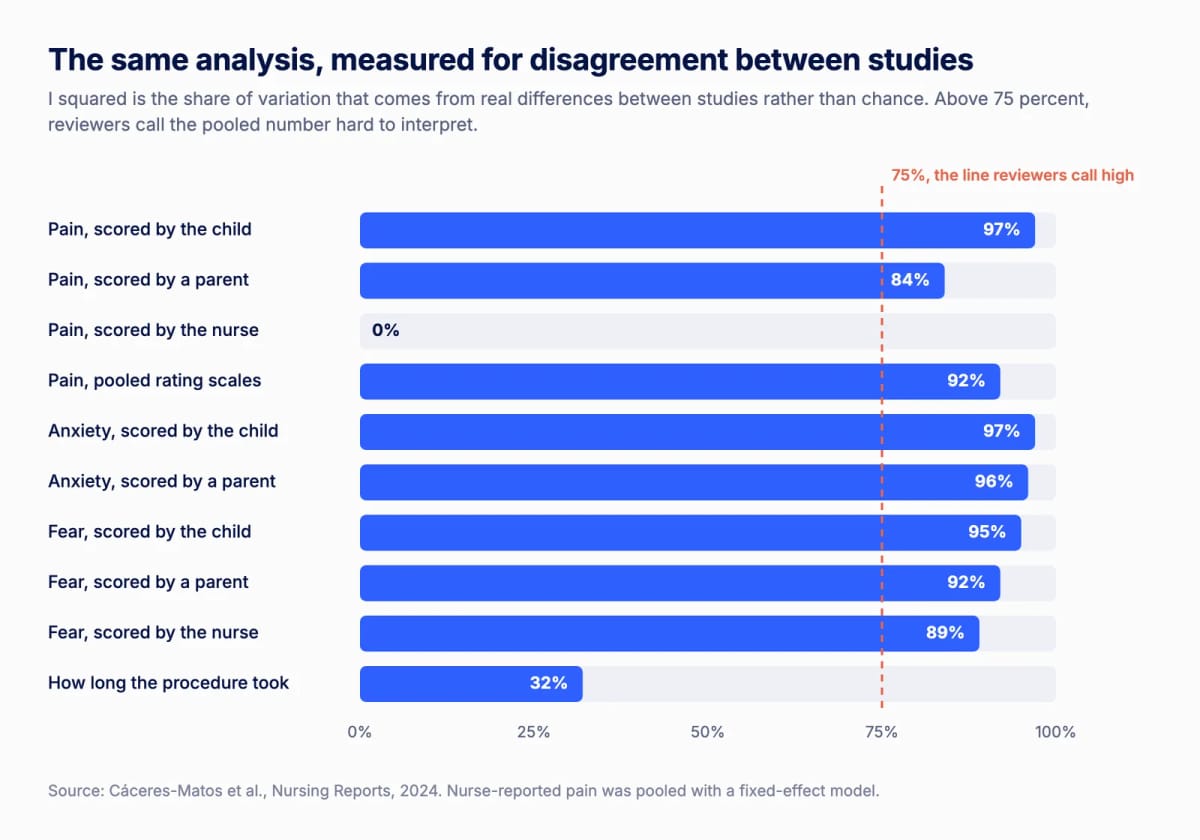
Most of the outcomes in this review sit between 84 and 97 percent. That is not a small wobble. It says the trials differed in ways that swamp the pooled number: a 6 year old getting an IV in a busy emergency department through a Google Cardboard viewer is not doing the same thing as a 15 year old at a phlebotomy desk with an Oculus Rift and a rollercoaster. The included studies ranged across Samsung Gear VR, Oculus Rift, HTC Vive and Cardboard, running snow worlds, aquariums, submarines and rollercoasters, in clinics on several continents.
Graded formally, the certainty of the evidence came out moderate to high for pain, moderate for fear, and low for anxiety. Tests for publication bias were clean everywhere except satisfaction.
Who scored the child changes the answer
One of the more quietly useful findings is that children, parents and nurses watched the same procedures and did not agree.
Nurse-scored pain produced the tightest result in the whole review, a 2.71 point gap with an interval of only a tenth of a point either side and an I squared of zero. Child-scored pain, on the same outcome, produced a smaller gap and a much wider interval. The observer numbers look cleaner. They are also the numbers most exposed to expectation, because the person scoring the child is often the person who handed over the headset and hopes it helped.
The child's own score is noisier, and it is also the one closest to what the child actually felt. Any honest reading of this literature has to hold both of those facts at once. We have written more about how individual trials handle this in our walk through the randomized trials on VR and blood draws.
What the review did not find
Two null results deserve more attention than they get.
Procedure time did not change. Across 750 participants the difference was 0.05 minutes, nowhere near statistical significance. Whatever else a headset does, in these trials it neither slowed the draw down nor sped it up.
And satisfaction split in an awkward way. Healthcare providers reported clearly higher satisfaction when VR was used. Patients and parents reported no significant difference at all. A tool that the staff love and the family shrugs at is a real finding, and it is worth sitting with rather than skipping past.
What has been published since
Two more recent syntheses point the same way without resolving the problem.
A 2026 meta-analysis focused only on pediatric emergency departments pooled 9 trials and 944 children, and found standardized mean differences of 0.64 for pain, 0.67 for anxiety and 0.56 for fear, all favouring VR. Its fear analysis had an I squared of 34 percent, far lower than anything in the 2024 review, which is what a more consistent set of studies looks like.
A 2026 umbrella review in the Journal of Pediatric Nursing went one level up and re-analyzed six existing meta-analyses covering 1,450 children. Effect sizes ranged from 0.5 to 3.5, heterogeneity ran from 81 to 100 percent, and every single analysis pointed in the same direction. Its authors concluded that VR meaningfully reduces needle-related pain and should be treated as a complementary tool.
Put together, the field's summary of its own summaries is this. The direction is reliable. The magnitude is not.
The age line running underneath all of it
The 2024 authors raised a point that rarely makes it into coverage. Headset manufacturers advise against use below a stated minimum age, and many of the trials enrolled children below it. That is not a reason to dismiss the research, but it does mean a study of 5 year olds in a Cardboard viewer and a study of teenagers in a consumer headset are describing different things. We have written separately about why headsets carry a minimum age of 10.
How to read a number like this one
When the next headline arrives, three questions do most of the work.
- Who did the scoring. Child, parent and nurse scores diverge, and observer scores are systematically larger in this literature.
- How much did the studies disagree. An I squared above 75 percent means the average is a summary of things that were not really alike.
- What was the comparison. Against standard care is an easier test than against another distraction method, and 423 of the participants in this review were in that harder comparison.
None of that makes the finding weak. Twenty one randomized trials pointing the same way is a real signal, and reviewers who grade it moderate certainty are not being dismissive. It just means the accurate sentence is narrower than the headline: across a varied and imperfect body of trials, children who were absorbed in something else reported less pain, fear and anxiety during needle procedures, by an amount nobody can yet pin down. More of the research behind this is collected on our science page.
Frequently asked questions
Does VR reduce pain during needle procedures in children?
Across randomized trials, children using VR report lower pain than children receiving standard care, and the 2024 meta-analysis found that on every scale it examined. Reviewers grade the certainty as moderate to high for pain and low for anxiety, mainly because the trials varied so much in age, device and setting.
How many children have been studied?
This review covered 2,663 participants aged 4 to 21 across 21 randomized trials, of which 18 contributed data to the pooled analysis. A 2026 umbrella review covering six meta-analyses reported 1,450 children, with substantial overlap between the reviews.
What does high heterogeneity mean in plain terms?
It means the studies being averaged were not really testing the same thing, so the average describes no particular clinic well. In this review most outcomes had an I squared above 84 percent, which is why the authors described a positive tendency rather than a settled effect size.
Do parents and nurses see what the child feels?
Not exactly. In this review parents and nurses both scored larger differences than children scored for themselves. Since nobody in these trials can be blinded, observer ratings carry more expectation, while the child's own rating is noisier but closer to the experience being measured.
Is VR better than other forms of distraction?
That question is much less settled. Most trials compare VR with standard care rather than with another distraction method, and only 423 of the 2,663 participants here were in that harder comparison. The evidence is not yet strong enough to rank distraction techniques against each other.
This article discusses published research on virtual reality generally. SendorVR has not been evaluated in these studies, and no product-specific claims are made or implied. SendorVR is a non-clinical comfort and engagement aid; all medical care remains with qualified healthcare professionals.

