The Two Minutes That Decide If a Patient Comes Back

Written by
Shabnam TaherniaShabnam Tahernia on LinkedInHead of Content
Almost nobody chooses a clinic on clinical quality. Patients cannot audit a phlebotomist's technique or compare vaccination protocols, so they judge the thing they can actually feel: how the visit went. And in a routine appointment, the part they feel most sharply is usually the needle.
That means the decision about whether someone books with you again, tells a neighbor about you, or quietly finds another clinic next year, gets made in a very small window. Not the whole appointment. The two minutes around the sharp bit, and the thirty seconds after it.
People remember the peak and the ending, not the average
The evidence for this is older than most patient experience consulting. In 1996, Donald Redelmeier and Daniel Kahneman had 154 patients undergoing colonoscopy and 133 undergoing lithotripsy rate their pain in real time, every 60 seconds, and then rate the whole experience afterwards. Their retrospective judgments tracked the most intense moment and the final three minutes, while the total duration barely registered. A long procedure that ended gently was remembered as better than a short one that ended badly.
Researchers call this the peak and end effect, and it is not a trick. It is how memory works on everyone, including the person filling in your survey a week later. For a clinic, it has an unusually practical consequence. A blood draw or an injection compresses the peak and the ending into roughly the same two minutes, which is a very short stretch of the day to be carrying that much weight.
What patients actually leave over
Accenture surveyed 8,000 US adults who had received care in the previous year, and about one in five had switched providers. Nearly 90 percent of them said the reason was that the organization was hard to deal with rather than clinically deficient. When those same people picked somewhere new, 53 percent went on a recommendation from someone they trusted.
Needles have their own version of this, and it is well documented. A systematic review and meta-analysis by McLenon and Rogers pulled together 119 studies and found needle fear in the majority of children, 20 to 50 percent of adolescents, and 20 to 30 percent of young adults. The same review reported that 16 percent of adult patients and 27 percent of hospital employees had avoided influenza vaccination because of it.
A survey by Taddio and colleagues of 883 parents and 1,024 children in Toronto found that 24 percent of parents and 63 percent of children reported fear of needles, and that needle fear was the main reason for skipping an immunization for 7 percent of parents and 8 percent of children. Blood collection shows the pattern most starkly. In a Hong Kong dataset of 729,347 whole blood donations, donors who had a vasovagal reaction were far less likely to ever come back, with an odds ratio of 4.4 against return. We went deeper into that pattern in why first time blood donors do not come back.
None of these numbers describe a marketing problem. They describe people declining to repeat an experience they did not enjoy, which is the most ordinary human behaviour there is.
Most of the two minutes costs nothing
Clinics that are good at this are rarely doing anything exotic. The common moves are small and mostly free.
- Say what is happening and when, without a countdown. Anticipation is where a lot of the distress lives, and "three, two, one" stretches it out.
- Position for comfort rather than restraint. Many pediatric clinics now sit a child upright on a parent's lap with the arm supported instead of laying them flat and holding them down.
- Give hands something to do. A squeezed ball, a phone, a parent's fingers to grip, anything that is not the tray.
- Move the sharps out of the sightline. What people watch is what they replay afterwards.
- Ask about fainting history before the tourniquet goes on, and recline the ones who say yes rather than waiting to find out. More on that in how to keep patients from fainting during blood draws.
- End on purpose. The last thirty seconds in the chair are the ones the person takes home, so that is a bad moment to be silently labelling tubes.
Parents get their own version of this, since a child who is frightened at four is a teenager who negotiates at fourteen. We wrote about that in how to help a child who is scared of shots.
Why a calmer chair is a competitive position
Small practices cannot outspend hospital groups on advertising, and they do not need to. The experience is the advertising. A family that had a fine time last November books again in November without thinking about it, and tells the other parents at the school gate when the subject comes up, which is exactly the channel that 53 percent figure describes.
There is an operational side too. A visit that stays calm is easier to keep on schedule, easier for a new staff member to run, and simply nicer to work in. Nobody trained for years in order to hold down a screaming six year old, and turnover in that job is not free either.
The competitive part is that hardly anyone treats those two minutes as a design problem. Waiting rooms get refurbished, booking systems get replaced, and the moment that decides the memory gets whatever the staff member improvises that day. A clinic that gets deliberate about it is differentiating on the one thing patients can actually judge.

Where SendorVR fits
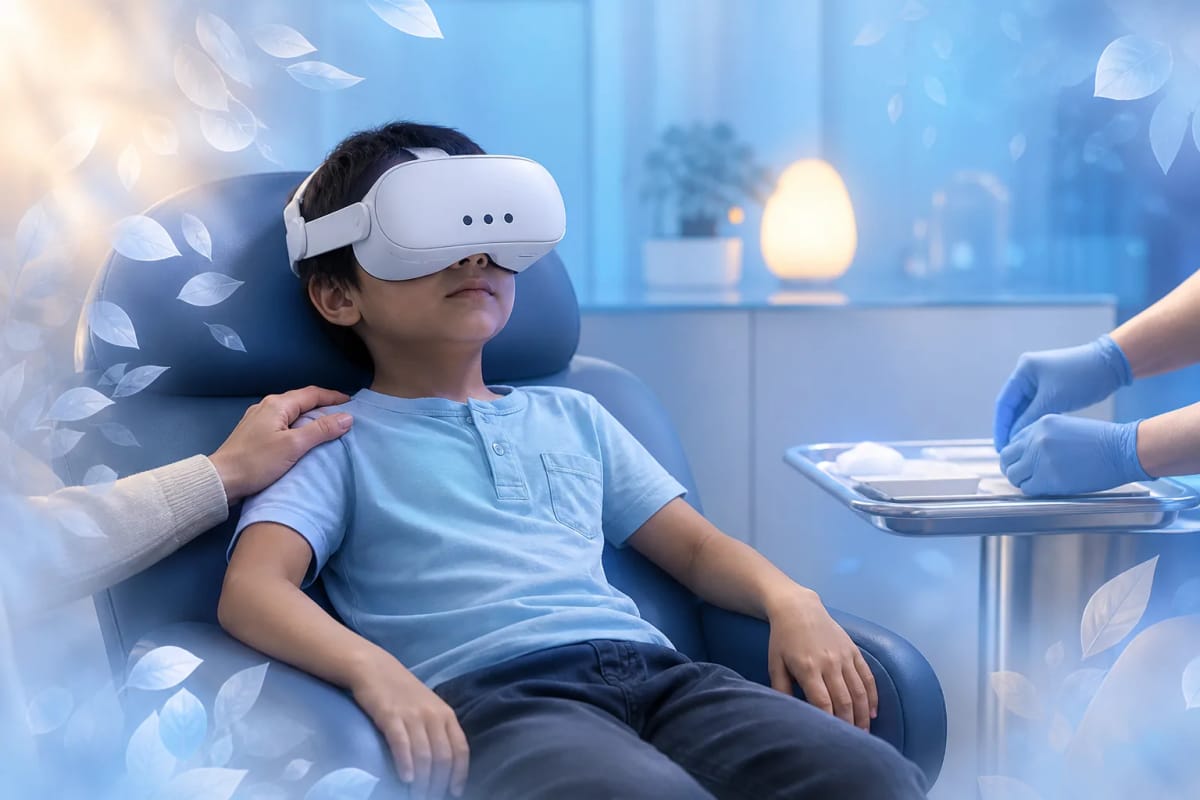
SendorVR is a non-clinical comfort and engagement amenity built for exactly that window. A nurse hands over a headset, launches a short activity that runs somewhere between 30 seconds and three minutes, and the person in the chair has somewhere else to put their attention while the staff work. The tray, the tourniquet and the needle are simply not in view.
It is designed to make a brief moment of care feel friendlier, and it is intended to sit inside the clinic's own routine rather than replace any part of it. All care stays with the clinical team. If you want a sense of how the content is chosen for such a short window, we covered it in choosing the right VR experience for a short clinical moment.
Frequently asked questions
Does patient experience really affect whether people return?
The survey evidence points that way. In Accenture's 2024 study of 8,000 US adults, around one in five had changed provider in the past year, and nearly 90 percent of those cited how difficult the organization was to deal with rather than the quality of the care itself.
Why focus on two minutes instead of the whole visit?
Because that is what memory does. Redelmeier and Kahneman's work on painful procedures found that people's overall verdict tracked the worst moment and the last few minutes, and was largely indifferent to how long the whole thing took.
How common is needle fear in adults, not just children?
More common than most clinics assume. The McLenon and Rogers meta-analysis reported needle fear in 20 to 30 percent of young adults, and adults tend to describe it less openly than children do, so it often shows up as a cancelled appointment instead.
What is the cheapest change a clinic can make tomorrow?
Ending the appointment deliberately. Thirty seconds of attention after the needle comes out, before the paperwork, costs nothing and lands on the part of the visit that people remember most clearly.
SendorVR is a non-clinical comfort and engagement amenity that clinics offer during short needle moments, giving people somewhere else to put their attention while staff work. If you run a practice and want to see what it looks like from the chair, book a demo.

