The History of the Needle, From Bronze Tubes to Patches

Written by
Shabnam TaherniaShabnam Tahernia on LinkedInHead of Content
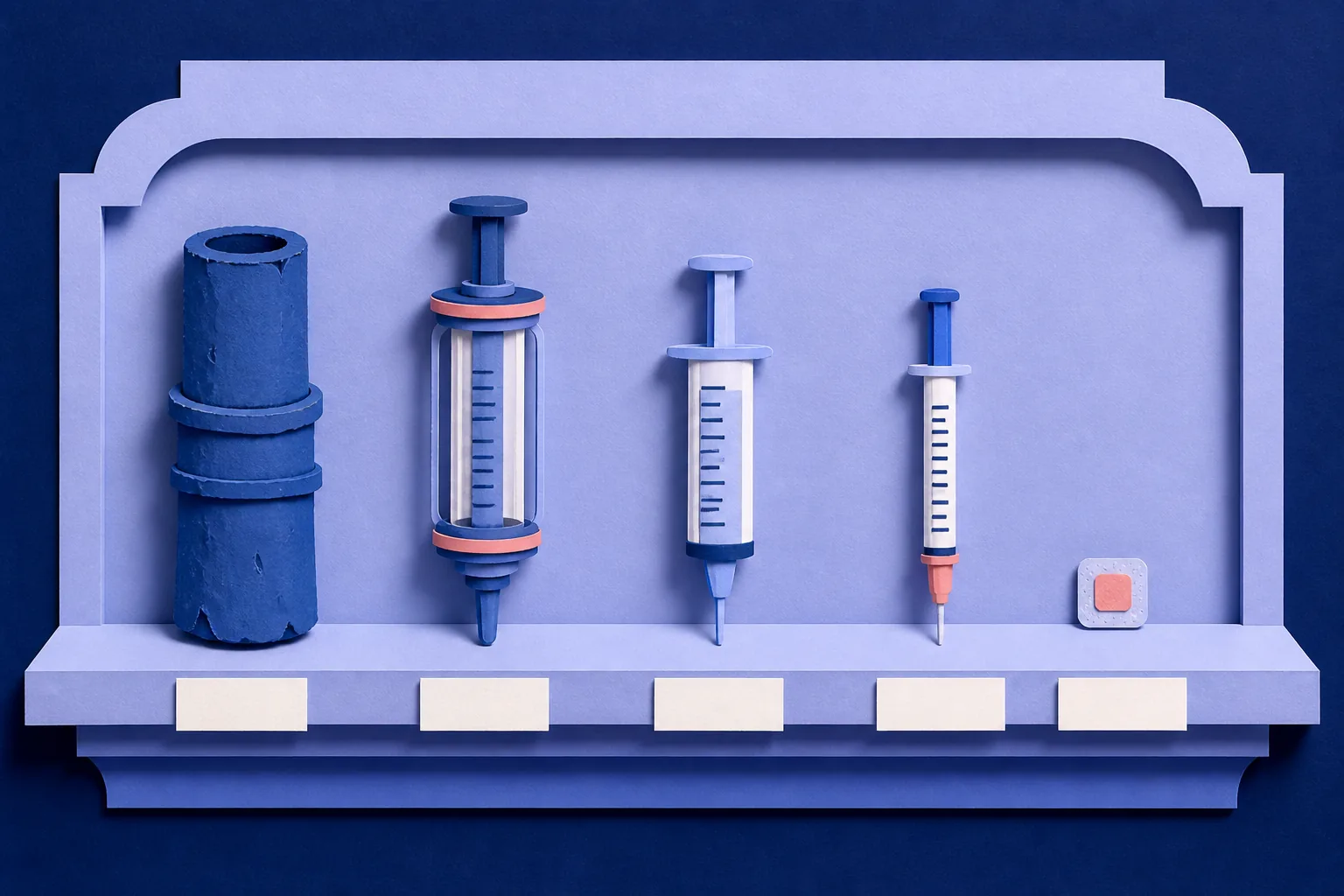
Somebody had to be first.
The object a nurse slides into your arm, the one that takes about four seconds and leaves a dot of blood under a cotton ball, has a paper trail running back roughly a hundred and eighty years. The rough prehistory runs back a great deal further.
Here is the short version before the long one. The hollow needle turns up as a working medical instrument in Dublin in 1844. The syringe that pushes fluid through it turns up in 1853, twice, in two countries, from two men who had no idea they were racing. Almost everything since has been refinement, and the refinement is the good part of the story.
Before the needle there was the tube

Ancient medicine had syringes. It did not have needles.
Greek and Roman practitioners used piston syringes, and Galen, writing in the second century, described devices of that sort for pushing ointments in and drawing thick fluids such as pus out. Cannulas for draining fluid from the abdomen have been found at Pompeii. Even the word is a hand-me-down. Syringe comes from the Greek syrinx, a pipe or a tube.
What all of these had in common is that they worked through an opening that already existed, or one a surgeon had already cut. Nothing in the kit was designed to make its own tiny hole in intact skin and put something useful on the other side. That was the missing idea, and it stayed missing for a very long time.
There is one striking near miss. In the tenth century the ophthalmologist Ammar ibn Ali al-Mawsili, born in Mosul and working in Egypt, described removing soft cataracts by suction, drawing the lens material out of the eye through a fine hollow tube. He was pulling rather than pushing, but he was working through a needle nine hundred years before anybody else made a habit of it.
A goose quill, a bladder, and a very drunk dog

In 1656, at Oxford, Christopher Wren was still decades away from designing St Paul's Cathedral and was busy with the kind of experiment that got a person invited into the circle which became the Royal Society. Working alongside Robert Boyle, he lashed a hollow goose quill to an animal bladder, opened a vein in a dog, and pushed things into the bloodstream to see what would happen.
Wine and ale, mostly. In a letter he reported having injected wine and ale into a living dog "into the Mass of Blood by a Veine, in good Quantities, till I have made him extremely drunk, but soon after he Pisseth it out". Opium and an emetic went into other animals.
Crude as it was, this was the first clear demonstration that a substance placed straight into the blood produces an effect you can sit and watch. Intravenous medicine starts here. So, less happily, does a long era of injections given through improvised equipment to subjects who had agreed to none of it.
1844, a hollow needle with no plunger

Francis Rynd was a surgeon at the Meath Hospital in Dublin, a keen horseman with a reputation for being excellent company. In May 1844 he treated a patient named Margaret Cox, whose facial neuralgia was severe enough that she could not sleep.
Rynd made small openings near the affected nerves and introduced a morphine solution through a fine tube, letting gravity carry the fluid in. There was no plunger. There was no pressure at all. The instrument was a trocar and cannula, which is to say the needle half of the equation with the syringe half still missing, and it worked well enough that the pain settled.
He published the case in 1845, then left the idea largely alone for another sixteen years before describing the technique properly. Historians generally hand him the hollow needle. Hardly anybody else does, because the thing that made needles famous had not been invented yet.
1853, the year two men invented the same object

Nine years after Rynd, in two cities that were not in touch, the other half arrived.
In Lyon, the orthopaedic surgeon Charles Gabriel Pravaz had the instrument maker Charrière build him a small silver syringe, roughly three centimetres long and five millimetres across, driven by a screw rather than a plunger so the dose crept in at a rate he could control. Pravaz was not chasing pain relief. He was injecting ferric chloride into aneurysms in the hope of clotting them. He died in 1853, the year the design appeared.

In Edinburgh, Alexander Wood arrived at the same object from a different direction. His syringe had a glass barrel, so you could watch the fluid and see how quickly it was going down, and a plunger instead of a screw. He used it to place morphine near the site of a patient's neuralgia, and published the method in 1855.
Two devices, one year, no contact between them. Wood got the credit, partly because glass and a plunger is still what a syringe looks like, and partly because he lived another thirty one years while Pravaz did not.
What "hypodermic" means, and who got to name it
The word arrived five years after the object. In 1858 Charles Hunter, a young house surgeon at St George's Hospital in London, put the term hypodermic into print, built from the Greek for "under" and "skin".
Hunter had also noticed something Wood never fully accepted. Wood injected morphine near the painful nerve because he believed the drug had to be delivered where it was meant to act. Hunter argued that the site barely mattered, because the drug travelled and worked on the whole system. Hunter was right, and the disagreement curdled into a long, sour priority dispute over who had really invented hypodermic medicine.
Wood won that one too. Hunter died in his early forties, and history has a habit of awarding arguments to whoever is still alive to attend the dinners.
One footnote is worth clearing up, because it surfaces every time this story gets told. There is a persistent tale that Wood's wife became the first person addicted to injected morphine and the first to die of an overdose from the instrument her husband had built. It is a tidy story and it is not true. Later accounts treat it as an urban myth.
The Victorian pocket kit

Look at what a hypodermic set looked like in the 1860s and you learn something about how the object was regarded.
Engraved silver case, hinged lid, fitted wells for a spare needle and a vial, a glass barrel with brass fittings and a thumb ring. It is a piece of jewellery that happens to inject. Doctors carried these the way they carried a pocket watch, and for a while the syringe was less a piece of clinical equipment than a badge of a thoroughly modern physician.
What went into it was mostly morphine. Injection made opiates faster, stronger and much easier to misjudge, and the second half of the nineteenth century learned that lesson slowly and expensively. The needle arrived as a delivery system some time before medicine had a settled idea of what it ought to be delivering.
A century of boiling, sharpening and using again
For the next hundred years a needle was not a disposable item. It was equipment.
Syringes were glass, needles were steel, and both were washed, boiled or autoclaved and used again. Needles went blunt and were sharpened by hand against a whetstone, then checked for burrs. Anybody taking insulin in the 1920s, after the hormone was isolated in Toronto and first given to a patient in 1922, was doing exactly this at home, with needles that ran roughly 19 to 26 millimetres long.
Read that again. Two and a half centimetres of steel, resharpened on a stone at the kitchen table, twice a day, for life.
The fittings improved in the meantime. The twist lock connection that stops a needle popping off a syringe under pressure, the Luer-Lok, was patented in 1930 by Fairleigh S. Dickinson, one of the two founders of Becton Dickinson. The taper it locks onto is still the standard fitting in your local clinic.
1949 to 1961, when the needle became something you threw away
Two men on opposite sides of the Tasman Sea share the credit here, and both had trouble being believed.
In Adelaide in 1949, Charles Rothauser produced the first plastic disposable hypodermic syringe, moulded in polyethylene. It solved a real irritation of the era: penicillin, then newly in wide use, gummed up glass syringes and made them miserable to clean. The catch was that polyethylene softens with heat, so his syringes had to be chemically sterilised, which made them expensive. In 1951 he moved to injection moulded polypropylene, which tolerates heat sterilisation, and the economics changed.
In New Zealand, a pharmacist and veterinarian named Colin Murdoch reached the same idea from a different direction. He had watched glass syringes carry infection between animals and between people, and in 1956 he patented a disposable plastic syringe. He took it to the health department, which turned it down on the grounds that nobody would want to be injected with something made of plastic.
The event that settled the argument was the Salk polio field trial. In 1954, Becton Dickinson supplied around a million sterile disposable syringes so the trial could vaccinate close to a million American schoolchildren, the Polio Pioneers, without anyone boiling anything in between. Once that has been done at that scale, going back to a wash bucket becomes unthinkable.
Two attempts to get rid of the needle entirely
Mass vaccination wanted something faster than one syringe per arm, and the twentieth century produced two answers. One of them worked beautifully.
The bifurcated needle is a short steel pin split into two prongs. It was invented by Benjamin Rubin, and in 1967 D. A. Henderson worked out the technique that made it famous: hold it at right angles to the skin and make about fifteen quick punctures inside a small circle. The prongs hold a precise droplet of vaccine between them by capillary action, so it used a fraction of the dose, cost almost nothing, and could be taught to a new vaccinator in minutes. India alone got through more than seven million of them. Smallpox was declared eradicated in 1980, and this two pronged pin is part of the reason.
The technique is still taught, because smallpox vaccine is still stockpiled. The Centers for Disease Control and Prevention demonstrates it in its vaccine administration training film, and it is worth watching purely for how unlike an injection it looks.

The second answer was the jet injector, which fired vaccine through the skin as a high pressure stream with no needle at all. Militaries and public health services used them from the 1950s onward, and anyone vaccinated in a queue in the 1960s or 70s stood a decent chance of meeting a Ped-O-Jet.
Then in 1985 a clinic in California traced an outbreak of hepatitis B to its jet injector, with 31 cases among people injected through the same multi-use nozzle. The nozzle touched skin, skin carries blood, and the machine was efficient enough to move it around. Multi-use-nozzle jet injectors were withdrawn from public health use, and the needle free future was postponed by about forty years.
Why a modern needle is less noticeable than an old one

Needle thickness is measured in gauge, and gauge runs backwards. The higher the number, the thinner the needle. That single fact explains most of what has happened to injections in the last forty years.
The first widely used insulin pen, launched in 1985, still carried a 16 millimetre needle. Today a syringe needle is commonly around 6 millimetres, and a pen needle can be 4 millimetres long and as fine as 34 gauge. When a 4 millimetre, 32 gauge pen needle appeared in 2010 it was the shortest and thinnest on the market, and competitors have gone finer since.
Thickness is not the whole story either. A review of a century of insulin needle design lists what actually decides how a needle goes in and how much of it is felt: diameter, length, the shape and sharpness of the tip, the insertion angle, how smoothly the shaft glides, and the number of bevels, which is to say the number of points where steel has to shear tissue instead of sliding through it. Modern needles are lubricated, multi-bevelled and made to tolerances that would have looked like science fiction to a nurse with a whetstone.
The safety century
The other force that reshaped the needle was what happens after the injection.
HIV and hepatitis turned a used needle from a cleaning problem into a serious occupational hazard, and the response came as engineering plus law. In the United States the Needlestick Safety and Prevention Act was signed in November 2000 and took effect the following April, requiring employers to use devices with built in sharps protection, to involve frontline staff in choosing them, and to keep a log of injuries. The CDC has estimated that the large majority of sharps injuries, as much as 88 percent, are preventable with safer devices and better practice.
Globally the scale is difficult to picture. The World Health Organization has put the number of injections given worldwide at roughly 16 billion a year, only about 5 percent of which are immunisations. Most are medicines. In 2015 it called for a worldwide switch to syringes that physically cannot be used twice, after estimates that unsafe injections were still causing large numbers of hepatitis B, hepatitis C and HIV infections.
The humble disposable syringe, in other words, is one of the highest volume manufactured objects on earth, and its design brief now includes what it does once it is empty.
What comes next, and it may be a sticker
The oldest ambition in this story is the one Wren would recognise. Get the substance in without the hole.
Microneedle patches are the current best answer. A patch about the size of a postage stamp carries a hundred or so needles a fraction of a millimetre long, moulded from dissolving material with the vaccine inside them. You press it on, the tips dissolve into the skin, and there is nothing sharp left to throw away. Georgia Tech, one of the groups that has worked on the approach for years, shows what a patch looks like at close range.
This is no longer a laboratory curiosity. In April 2024 The Lancet published a phase 1/2 trial from The Gambia in which a measles and rubella vaccine was given by microneedle patch to 45 adults, 120 toddlers and 120 infants, against conventional injection. Among the infants, 93 percent seroconverted for measles with the patch against 90 percent with the injection, and rubella seroconversion was 100 percent in both groups. The researchers reported no safety concerns.
Patches do not need a trained injector, they travel more easily, and they generate no sharps. If they clear the remaining hurdles, a meaningful share of those 16 billion annual injections could stop being injections at all.
The part the needle never solved
Here is what all of that engineering did not fix.
The needle got thinner, shorter, sharper, single use and much safer. The four seconds still frighten a great many people. Needle fear is one of the most common fears there is, it usually starts young, it often does not fade with age, and in clinics it shows up as postponed blood tests and rescheduled vaccinations rather than as anything anybody says out loud.
The Canadian Institutes of Health Research put the obvious question to a researcher in a short explainer, and the answer is more interesting than yes or no.
None of this is a hardware problem, which is probably why a hundred and eighty years of hardware improvement has not shifted it much. It is a question about attention, expectation, and what a person is doing with their mind during those four seconds. Clinics have worked on that for a long time with positioning, conversation, timing, numbing cream, and lately with something more interesting to look at than a tray.
If you want the current state of that half of the story, we have written about why so many adults quietly avoid blood tests, how to help a child who is scared of shots, and seven things that make a shot easier to face.
SendorVR works at that end of the problem. The needle itself has been refined for a century and a half. The minute around it has not had anything like the same attention, and that minute is what we build for.
Common questions about the history of the needle
Who invented the hypodermic needle?
Credit is usually split. Francis Rynd, in Dublin, used a hollow needle to deliver a drug under the skin in 1844, with no syringe attached. In 1853 Alexander Wood in Edinburgh and Charles Gabriel Pravaz in Lyon independently built syringes that could push a measured dose through a needle. Wood is the name that stuck.
Where does the word hypodermic come from?
From the Greek for "under" and "skin". Charles Hunter, a London house surgeon, put it into print in 1858, five years after the instrument itself appeared, and spent much of the following decade arguing with Wood about who deserved the credit.
When did needles become disposable?
Plastic disposable syringes were made in Adelaide by Charles Rothauser from 1949 and patented in New Zealand by Colin Murdoch in 1956, but the turning point was the 1954 Salk polio field trial, which used around a million sterile disposable syringes at once. Before that, syringes were glass and needles were washed, boiled and resharpened by hand.
Why do modern needles feel different from older ones?
Mostly thickness and geometry. Insulin needles have gone from 19 to 26 millimetres long, sharpened on a whetstone at home, to 4 millimetre pen needles as fine as 34 gauge, with lubricated multi-bevelled tips designed to shear as little tissue as possible on the way in.
Will patches replace needles?
For some vaccines, possibly. A 2024 trial in The Gambia found that a measles and rubella microneedle patch produced immune responses comparable to injection in infants, with no safety concerns reported. That is one trial and the technology is not in routine use yet, but it is the most credible needle free route anyone has produced so far.


_Wellcome_L0007299.jpg)


.jpg)
